ZESA Finances Threaten Industrial Competitiveness
Treasury Rates Electricity Businesses At Highest Risk

- Treasury's 2027 Fiscal Risk Statement assigned Category 5, its highest risk rating to both ZESA Enterprises and ZETDC across current ratio, debtor turnover, and debt-to-EBITDA metrics based on 2025 audited accounts
- Utility liquidity constraints and a 500MW national generation shortfall threaten mining and manufacturing expansion, compounded by business electricity tariffs of ~US14.21 cents/kWh—above regional benchmarks
- While government pursues cost-reflective tariffs and thermal rehabilitations like Hwange Unit 5, financial recovery requires entity-specific interventions under Mutapa Investment Fund oversight
Harare- Zimbabwe's electricity sector is confronting a financial problem that extends beyond generation shortages and the cost of supplying power to industry. Treasury has assigned the highest overall financial risk classification to two major electricity entities, exposing weaknesses in liquidity, debt servicing and financial sustainability within a sector central to national industrialisation.
The findings come as Government advances cost reflective electricity tariffs and prepares additional investment in power generation and transmission infrastructure. For mining companies, manufacturers and other electricity intensive businesses, the financial condition of the national power supplier is becoming an increasingly important determinant of production costs, operational reliability and investment returns.
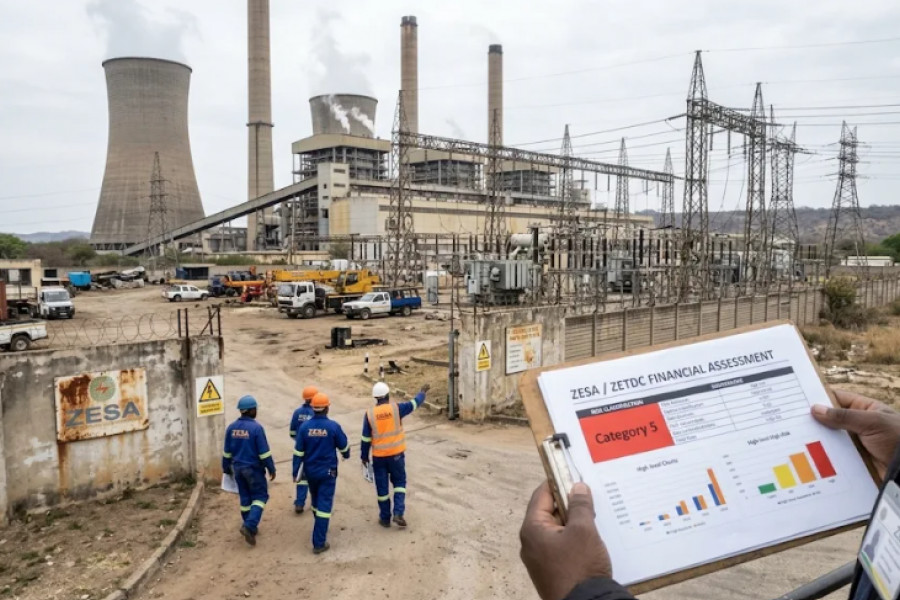
According to Zimbabwe's 2027 Fiscal Risk Statement, published by the Ministry of Finance on 19 November 2026, ZESA Enterprises received Category 5, the highest risk classification, across all seven indicators used to assess profitability, liquidity and solvency.
Zimbabwe Electricity Transmission and Distribution Company, ZETDC, also received an overall Category 5 assessment, recording the highest risk classification for its current ratio, debtor turnover and debt relative to earnings before interest, taxation, depreciation and amortisation. The assessments are based on 2025 audited financial statements and expose considerable financial weaknesses in businesses responsible for critical components of Zimbabwe's electricity infrastructure.
The distinction between the two entities is important. ZESA Enterprises operates within the electricity group's commercial and engineering activities, while ZETDC is responsible for electricity transmission, distribution and customer supply. Their financial vulnerabilities arise within different business models and require different operating responses.
Treasury's assessment nevertheless establishes that financial weaknesses extend across important functions within the electricity group, increasing the importance of examining how revenue collection, operating costs and financing obligations affect the sustainability of power delivery.
ZETDC's assessment is particularly consequential for the wider economy. The company received Category 4 ratings for return on assets, return on equity and cost recovery, alongside Category 5 ratings for its current ratio and debtor turnover. These classifications point to challenges in generating adequate returns, collecting receivables and maintaining sufficient short term resources to meet obligations. Its Category 5 debt to EBITDA classification adds another dimension to the pressure, placing debt servicing capacity among the areas requiring intervention.
For an electricity distributor, weak liquidity can affect the entire operating chain. Delayed customer payments constrain the funds available to settle electricity purchases, maintain substations, replace transformers and finance network upgrades. Insufficient investment in distribution infrastructure can increase technical losses and compromise reliability, while collection failures place additional pressure on the tariffs charged to paying customers. The interaction between commercial performance and technical infrastructure is consequently important to electricity affordability and the financial viability of ZETDC.
This position carries substantial implications for mining. Zimbabwe's mining industry depends on reliable power for extraction, mineral processing, ventilation, pumping and the operation of capital intensive equipment. Interruptions disrupt production schedules and increase reliance on alternative energy sources, while higher tariffs can weaken the operating margins of producers competing in international commodity markets.
The Chamber of Mines of Zimbabwe's 2026 industry survey identifies an electricity tariff of approximately US14.21 cents per kilowatt hour for business consumers, above the regional comparisons examined in the survey. The combination of relatively high electricity costs and continuing supply constraints places additional pressure on the competitiveness of domestic mineral production.
The financial condition of ZETDC therefore warrants examination alongside the electricity pricing framework. Government has pursued cost reflective tariffs to improve the financial sustainability of the power sector, while the 2027 Infrastructure Investment Programme credits the approach with strengthening ZESA's ability to maintain infrastructure and meet operating requirements.
Treasury's separate financial risk assessment demonstrates that significant weaknesses remained in the underlying electricity businesses during the 2025 reporting period. The different reporting periods prevent a conclusion that subsequent tariff adjustments have failed, although they establish the importance of measuring the financial outcomes of those adjustments against audited operating results.
The consequences extend to industrial policy. Zimbabwe is seeking greater domestic processing of minerals, expanding manufacturing capacity and promoting local procurement to reduce dependence on imports. These objectives require industrial electricity supplies that are commercially competitive, sufficiently reliable and available at the scale needed for new investment. Where utilities struggle to finance maintenance and network expansion, the benefits expected from industrial incentives and new manufacturing investment become more difficult to realise.
The electricity deficit acknowledged in the 2027 Infrastructure Investment Programme further complicates the position. Treasury estimates a generation shortfall of approximately 500 megawatts despite reporting installed capacity of 3,412 megawatts. The government is pursuing rehabilitation of existing thermal generation units, renewable energy expansion and additional transmission investments, including regional interconnectors.
Such projects can increase available supply and improve reliability, with their financial returns dependent on power purchase arrangements, customer collections and the operating condition of the network receiving the electricity.
The planned refurbishment of Hwange Unit 5 illustrates this relationship. Government expects the project to restore approximately 160 megawatts of capacity during 2027, providing additional domestic generation that could reduce dependence on imported electricity under suitable operating conditions. The financial benefit to the electricity system will depend on the cost of restoring and operating the unit, the reliability of its output and ZETDC's ability to recover the cost of electricity supplied to customers. Additional generation can support economic activity, while the underlying commercial arrangements determine its contribution to the utility's financial recovery.
ZESA Enterprises faces an equally substantial corporate restructuring challenge. Treasury assigned Category 5 to all seven indicators, including return on assets, return on equity, cost recovery, liquidity, debtor turnover and leverage measures. Such a comprehensive classification requires closer examination of the company's revenue model, the condition and utilisation of its operating assets, the concentration of receivables and the financial obligations associated with its business activities. Its performance cannot be assessed solely through the wider electricity group's generation capacity or the national tariff structure.
The wider public finance consequences are significant because financially distressed state enterprises can create claims on the national budget. Treasury warns that weaknesses in profitability, liquidity and solvency may lead to requests for financial support, government assumption of debt, calls on guarantees and further payment arrears. The potential obligations extend beyond the entities themselves, affecting the amount of fiscal resources available for infrastructure, education, healthcare and other development programmes.
Zimbabwe's Public Debt Report provides additional context for this exposure. The document identifies substantial arrears associated with externally financed infrastructure projects, including approximately US$126.6 million on the Hwange Units 7 and 8 facility and US$82.9 million relating to the Kariba South extension.
These amounts are project financing obligations and should be distinguished from the financial risk classifications assigned to ZESA Enterprises and ZETDC. Together, the disclosures demonstrate the need to evaluate electricity investment through the cash flows required to operate assets and service the associated financing.
The scale of the challenge is compounded by the rising demand for electricity from domestic mining and manufacturing projects. Greater mineral beneficiation, industrial construction and agricultural processing increase the requirement for dependable power, while companies investing in captive generation face their own capital and operating costs.
An electricity system capable of supporting industrialisation must therefore address generation availability, grid performance, financing and collections as parts of the same commercial operating framework.
The regional dimension is equally important. Zimbabwean mining and manufacturing businesses compete for investment against producers operating in South Africa, Zambia and other regional markets. Differences in electricity costs, grid reliability, transmission access and the ability to negotiate long term supply arrangements can influence where new processing plants and industrial facilities are established. Evaluating Zimbabwe's competitiveness requires examining the full cost of delivered electricity, including interruptions, backup generation, connection charges and contractual reliability.
For ZETDC, the immediate corporate priorities should centre on receivables collection, the composition of outstanding customer debt, the recovery of purchased electricity costs and the financing of essential network maintenance. Directors require a clearer assessment of debtor ageing, collection efficiency, electricity losses and the operating cash flow generated from each major customer category. These measures provide a more direct basis for evaluating financial recovery than tariff adjustments or revenue growth in isolation.
For ZESA Enterprises, the priority is establishing a viable commercial model supported by productive assets, recoverable receivables and operating activities capable of covering their costs. The persistence of the highest risk classification across every assessed measure calls for an asset and business line review, including the commercial contribution of individual activities and the funding required to restore sustainable operations.
Treasury's proposed reforms include stronger corporate governance, improved financial reporting, operating cost rationalisation and greater oversight of entities under the Mutapa Investment Fund. The effectiveness of these measures will depend on the publication of current audited financial statements, clearly assigned restructuring responsibilities and measurable improvements in the indicators that produced the risk classifications. Transparency is particularly important where financially distressed public entities provide essential services and remain exposed to government support.
Equity Axis takes the view that Zimbabwe's electricity investment strategy requires a stronger connection between operating performance, tariff policy and the financial condition of the companies delivering power. The highest risk classifications assigned to ZESA Enterprises and ZETDC establish the need for targeted restructuring, with separate recovery plans reflecting their different commercial responsibilities. It recommend ZETDC should prioritise collections, network losses and the cash conversion of electricity sales, while ZESA Enterprises requires a comprehensive assessment of profitability and asset productivity. Future tariff decisions and investment approvals should be supported by transparent financial performance targets, with directors accountable for the relationship between customer revenue, operating expenditure and debt servicing.
For mining and manufacturing investors, the quality of electricity infrastructure will continue to influence project economics and the viability of domestic processing. Financially sustainable utilities can improve the reliability of existing supply, support new industrial connections and reduce the need for expensive alternative power arrangements. Zimbabwe's industrial ambitions therefore require measurable improvements in the electricity sector's commercial performance alongside investment in additional generating and transmission capacity.
Treasury's financial risk assessment provides a basis for examining the economic cost of maintaining essential electricity services through businesses with severe financial weaknesses. The next stage of electricity sector reform should establish the financial resources required, the operating improvements expected and the commercial responsibilities assigned to each entity. The success of Zimbabwe's power investment programme will ultimately depend on electricity reaching productive users reliably and the institutions delivering it generating enough cash to sustain the system.
Equity Axis News