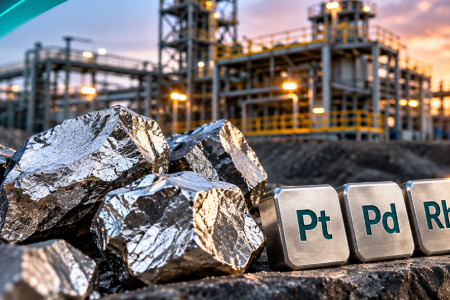
- PGM exports generated USD 1.206 billion, with PGM matte contributing USD 859.1 million, confirming that the shift from raw concentrates to processed matte is now delivering at scale
- Most PGM matte is still exported to South Africa for final refining, meaning Zimbabwe captures only about 40% of the final metal value
- Zim needs to establish a domestic PMR, supported by structured financing, a price-linked royalty regime, and the development of a hydrogen economy industrial zone
Harare- Zimbabwe's platinum group metals industry has generated US$1.206 billion in export earnings during the first half of 2026, with locally produced matte contributing US$859.1 million and concentrates accounting for US$347.6 million. Matte represented approximately 71% of PGM export earnings, demonstrating the increasing contribution of domestic smelting to the country's mineral beneficiation programme. The expansion establishes a stronger industrial base for the Great Dyke, although the continued export of matte for further processing leaves Zimbabwe dependent on foreign refining facilities.
According to the Minerals Marketing Corporation of Zimbabwe, the country's PGM export composition has changed substantially as producers expand smelting capacity and processing arrangements. The next phase of industrial development requires greater domestic participation in base metal and precious metal refining, where individual metals are separated for sale into international markets. The challenge concerns the financing and sequencing of this investment, particularly as Government strengthens its commitment to domestic mineral processing under the National Development Strategy 2.
Industry analyst from CZI said the jump from raw concentrates to smelted matte proves domestic beneficiation works at scale, but warn that the finalan d most lucrative stage of value capture still happens across the Limpopo.
"Smelting concentrates into matte lifts realised export value nearly tenfold per tonne, which is why matte now generates over 70% of Zimbabwe's PGM receipts, yet shipping matte to South Africa for base and precious metal separation means Zimbabwe is still capturing roughly 40% of the final refined value while paying external tolling and refining charges."
MMCZ's 2025 results demonstrate the progress already achieved. PGM concentrate export volumes declined by 52% to 73,506 tonnes, while associated earnings fell by 44% to US$306 million. Matte exports reached 37,194 tonnes, generating approximately US$1.5 billion, a 71% increase in revenue. The shift followed greater utilisation of smelting and toll processing arrangements, establishing matte as a major contributor to mineral export receipts.

The difference between the products is substantial. Matte generated approximately US$40,330 per exported tonne in 2025, compared with US$4,163 for concentrate, representing a ratio of about 9.7 times. Matte contains a higher concentration of payable metals and requires additional processing expenditure, making the comparison unsuitable as a direct measure of beneficiation profits. The figures nevertheless demonstrate the higher value concentration achieved when mineral concentrates undergo smelting.
The transition continued into 2026. During the first quarter, concentrate sales volumes increased by 98% to 30,178 tonnes, while earnings rose by 319% to US$191.73 million. Matte sales generated US$352.24 million, bringing combined PGM receipts to approximately US$544 million. The stronger first half performance confirms the growing role of matte production within Zimbabwe's mineral export structure.
The remaining industrial opportunity lies in processing matte further. Base metal refining removes nickel, copper and other metals from intermediate material, while precious metal refining separates platinum, palladium, rhodium and other PGMs into individually marketable products. Zimbabwe's established producers continue to utilise refining networks outside the country, particularly in South Africa, where the necessary infrastructure and technical expertise are already available.
Domestic refining could expand specialised metallurgical activity, technical employment and the range of products generated from Zimbabwe's mineral resources. Its commercial value would depend on the cost of establishing and operating local facilities compared with existing international refining arrangements. Metal recovery, electricity, water, financing and the reliability of feedstock would determine the economic returns from the investment.
An official at MMCZ, speaking on condition of anonymity, said deeper processing remains in the pipeline. "It is something in the pipeline. When the time is right, it will be communicated. So far matte is a big step," the official said.
The comment acknowledges the progress achieved through domestic smelting while placing the next stage of processing within a longer industrial development programme. Zimbabwe has already demonstrated that producers can expand local processing when suitable infrastructure and commercial arrangements exist. Further beneficiation would require coordinated investment in facilities capable of treating material produced across the country's PGM operations.
Zimplats provides an important example of that investment. The company has expanded its smelting capacity to approximately 380,000 tonnes of concentrate annually and is advancing the refurbishment of its Base Metal Refinery at Selous. The refinery programme carries a budget of US$190 million, with approximately US$36 million reported as spent in the information available for the original investigation.
The facility is intended to separate base metals from precious metal bearing material, establishing an important processing stage before individual PGM separation. Its development creates an additional domestic metallurgical capability, although a precious metal refinery would require further investment and a separate assessment of commercial viability.
Economist Zvikomborero Sibanda told Equity Axis that beneficiation policy should move step by step and recognise the capital Zimplats and other producers are already committing before new processing obligations are introduced. His argument places the timing of regulation within the industry's existing investment commitments, acknowledging that mines must continue financing production and development while expanding downstream capacity.
Zimbabwe's established PGM producers include Zimplats, Unki and Mimosa, while projects involving Karo Platinum, Great Dyke Investments and Bravura could expand future processing requirements. The potential for a shared precious metal refinery would depend on the volumes and composition of material available from these operations, their development schedules and the contractual arrangements governing existing refining services.
Sibanda identified the establishment of a refinery financing structure within the 2027 budget cycle as one of three important policy commitments. Indicative estimates previously discussed for a precious metal refinery ranged from US$300 million to US$500 million, although the actual investment requirement would depend on plant capacity, processing technology and associated infrastructure. A project specific feasibility study would be needed to determine the appropriate development cost.
A shared processing facility offers one potential financing model. Producers could combine equity contributions with institutional investment, development financing and specialist technical partnerships. Government participation through an appropriate investment vehicle could also be considered, provided the project demonstrates commercial viability and transparent arrangements for ownership, operations and financial obligations.
Long term feedstock commitments would be particularly important. Participating producers would need to agree on material volumes, metal accounting, tolling charges and the allocation of processing costs. International offtake agreements could strengthen revenue certainty, while technical studies would need to establish that domestic recovery rates and operating costs can compete with established South African refining facilities.
The European Union's Critical Raw Materials Act provides additional context for international processing partnerships. Its objectives include greater diversification of strategic mineral supply chains and increased processing capacity. Zimbabwe could explore technology, investment and marketing relationships with industrial businesses seeking alternative sources of processed minerals, subject to commercially viable project arrangements.
The second policy commitment concerns the structure of PGM royalties. Sibanda proposed a price responsive mechanism similar to the framework applied in Zimbabwe's gold industry, allowing royalty obligations to adjust as commodity prices change. Such an arrangement would recognise the cyclical nature of PGM markets and the substantial capital requirements of underground mining and metallurgical processing.
The Chamber of Mines has advocated a progressive platinum royalty structure with lower rates during weaker price periods and higher rates when market conditions strengthen. This approach could improve the predictability of investment returns by reducing the relative fiscal burden during downturns while allowing Government to participate more fully in stronger commodity markets.

A commercially appropriate framework would need to account for the combined value of platinum, palladium, rhodium and other recovered metals. Different PGMs experience independent price movements, while mining companies face operating costs and investment obligations that do not necessarily decline at the same rate as revenue. Royalty design should consequently consider mine economics, existing fiscal obligations and the capital needed for further beneficiation.
The third consideration concerns the use of regulatory deadlines. Zimbabwe suspended raw mineral and lithium concentrate exports in February 2026, placing greater emphasis on local processing and the prevention of mineral export irregularities. The intervention provides a precedent for linking mineral export permission to domestic beneficiation commitments, although its application to PGM matte requires recognition of the substantial processing already undertaken.
A phased framework could introduce future processing obligations once a domestic refinery has secured financing and progressed towards commissioning. Producers could be required to demonstrate investment commitments or contracted access to local refining capacity, with implementation linked to facilities capable of processing the relevant material. Such sequencing would establish clear development requirements while protecting existing production and export earnings during construction.
South Africa's PGM industry provides a useful regional comparison. Its established refining infrastructure supports specialised metallurgical services and downstream manufacturing, including autocatalysts used in vehicle emission control systems. The development of these activities demonstrates the industrial opportunities associated with refined mineral supply, technical expertise and relationships with international customers.
Zimbabwe could pursue similar opportunities as domestic processing capacity expands. The immediate requirement would be the establishment of reliable refining operations, followed by investment in businesses capable of using refined metals as industrial inputs. Engineering services, specialised chemicals and component manufacturing could broaden the economic contribution of the Great Dyke beyond extraction and intermediate mineral processing.
Sibanda's third proposal involves establishing a hydrogen economy industrial zone near Selous or in the Midlands, using proximity to PGM resources and future refined metal supply to attract manufacturers. Platinum and iridium are used in selected fuel cell and electrolysis technologies, creating potential opportunities for catalyst production and related industrial activities.
International investment in hydrogen technologies provides a possible future market. The European Hydrogen Bank's first auction awarded approximately EUR720 million to renewable hydrogen projects in 2024, demonstrating financial support for the development of the sector. Zimbabwe's participation in these supply chains would depend on access to technology, reliable infrastructure, commercially competitive refined metals and confirmed demand for manufactured components.
The proposed industrial zone would therefore represent a longer term development opportunity, following the establishment of domestic refining capacity. Investment would need to be supported by identifiable industrial customers, suitable production infrastructure and financing arrangements appropriate to the businesses involved.
Equity Axis takes the view that Zimbabwe's progress in matte production has established a credible foundation for further PGM beneficiation, with the next phase requiring a coordinated investment programme supported by clear processing milestones. The country's US$1.206 billion first half export base and existing smelting investments provide substantial evidence of industry scale. Government should establish a technical and financing framework for domestic precious metal refining, supported by committed producer feedstock and a royalty structure responsive to commodity price movements. Future matte processing requirements should follow the development of commercially viable domestic facilities, allowing producers to plan investment and preserve operating cash flows.
The immediate priorities are the successful advancement of Zimplats' Base Metal Refinery, completion of credible feasibility work for precious metal refining and establishment of financing arrangements that distribute project obligations across participating producers. These measures would provide a practical route towards implementing the beneficiation objectives contained in NDS2.
Zimbabwe has expanded its capacity to produce higher value PGM intermediates and strengthened the contribution of domestic smelting to mineral export earnings. Developing competitive refining infrastructure would create opportunities for additional metallurgical services and manufacturing activity. The next stage depends on converting the existing production base into viable processing investments supported by predictable policy and sustained commercial demand.
Equity Axis News